
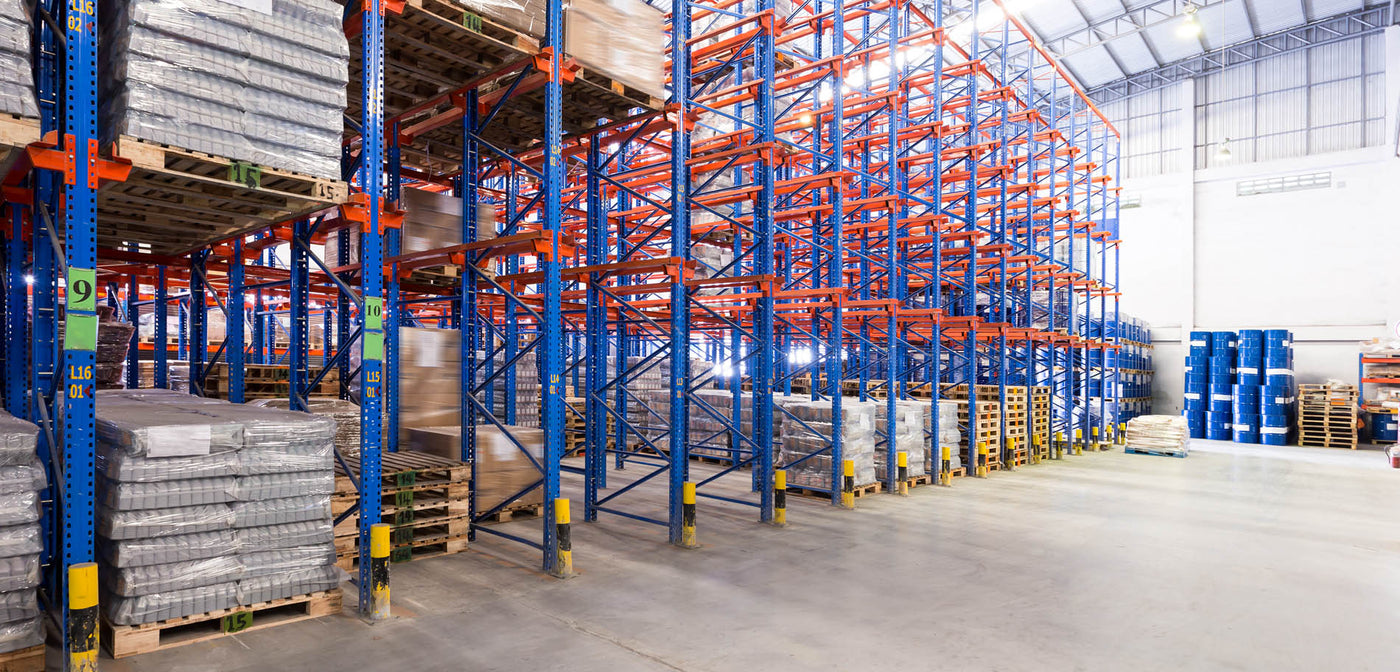

Pallet Racking
Engineered Solutions design, manufacture and install Pallet Racking Solutions throughout the UK. We have a large selection of rack shelves available to fit all environments, including Heavy Duty Racking, Industrial Racking and fully Automated Pallet Racking Systems.
We offer an initial free-of-charge site visit to fully understand your requirements, where we will share our expertise and advise you on the best system to fit the needs of your operation.
Our engineering team design Pallet Racking systems to meets your exact requirements, from design, manufacture and installation we will advise you on the best solution to maximise your available footprint, from standard racking through to fully automated.
Outlined below is the vast range of solutions we have available, why not take advantage of our free consultancy service where one of our engineers will visit you on site to discuss your requirements and advise you on the best one to fit your needs.
Example Pallet Racking Projects


The highest density storage achievable is block stacking for example containerised, stock which can be erected by forklift and is limited by the stability of the outer casing or packing. However once you start to require individual accessibility, you need a shelf or level to store the pallet or container and that is where pallet racking comes in. The rest is down to systems, planning and engineering.
Pallet Racking falls into 4 main groups:-
1) General Purpose Pallet Racking
2) Medium Density Pallet Racking Storage
3) High Density Pallet Racking Storage
4) Automated Pallet Racking
We have the technical teams to construct handling systems in manual and bulk to maximise your use of space, minimising your footprint and ensuring that your picking teams are focused on key turnaround operations.

1. General Purpose Pallet Racking
This covers everything from work in progress, goods receiving to small works stores.
Pallet racking projects for counterbalance trucks are the simplest, most common type of pallet organisation. It’s a low density system which makes use of low cost handling systems, such as stackers and counterbalanced forklifts.
However there are a number of variants of pallet racking which are designed around specialist forklift trucks. At Engineered Solutions we handle articulated trucks and four directional trucks as part of our range specific to the systems we build.
2. Medium Density Pallet Racking StorageThis describes the minimum aisle space achievable with maximum access to unit storage. This can often include break bulk and hand picked stock as well as palletised. There are many systems and lots of equipment associated with these types of storage which are the most common.
3. High Density Pallet Racking
High density pallet racking storage systems are the equivalent of block stacking and it suits stock which needs to be picked in a particular order or stock which is not time sensitive.
It’s not as accessible as medium density storage systems, but it allows a high degree of accessibility.
Need a Quote?
Get in-touch with your exact requirements
Adjustable Pallet Racking (APR) — Frequently Asked Questions
1. How many types of pallet racking are there, and what does each one do — which kind of business runs which?
1. How many types of pallet racking are there, and what does each one do — which kind of business runs which?
Short answer: There's a spectrum, and they sort by one thing: how you trade space against access. Selective adjustable pallet racking (APR) is the default — every pallet reachable, suits almost everyone. The denser systems — drive-in, push-back, pallet-flow, double-deep, mobile — buy you space by giving up some access. The specials — cantilever, narrow-aisle, shuttle and full automation — answer a particular problem. Match the system to how you actually pick, not to a brochure.
Podcast answer: Run down the spectrum and what each one's for. Before that, the thing to hold onto: it's all housed in pallet racking. Every system here — drive-in, live storage, mobile, the maturation flow lanes, right up to the automated shuttle — is the same structural steel rack underneath, configured a different way. They're not separate furniture; they're the dense and dynamic settings of one family, governed by the same standards and inspected the same way. Change the configuration and you change how you trade space against access, but the steel and the rules behind it don't change.
Selective APR is the workhorse — every pallet on the face, reach any one any time. From a single-bay workshop to a national DC, if in doubt this is it.
Double-deep is APR two pallets deep, reached with a longer-reach truck. You lose direct access to the back pallet but win roughly a third more storage. Suits a busier operation with several pallets of the same line.
Drive-in and drive-through pack pallets solid with the truck driving into the lane. Drive-in is load and unload from one end — first in, last out (FILO). Drive-through is open both ends and runs as a marshalling system — load one end, draw off the other, first in, first out (FIFO). Cold stores, food, drink, high-density same-product holding. Space is king, access is sacrificed.
Push-back and pallet-flow (live storage) use gravity on inclined rollers — no truck inside the lane, the pallet does the travelling. Push-back loads and retrieves from the front (last in, first out); pallet-flow loads one end and picks the other (first in, first out, proper stock rotation). Distribution and food where date order matters and throughput is high. The same roller system does a second job most people miss: timed maturation. Because the lane moves stock at a controlled rate from load end to pick face, it becomes a conveyor that ages product for you — load it green at one end and it arrives ready-to-go (RTG) at the other. Whisky maturation is the obvious one; the same principle runs the battery-maturation process — automated flow racks (dynamic warehousing) carry the old alkaline cell or the new lithium through its set maturation time so the pick face only ever presents product that's ready. The shelf isn't just storing the stock, it's timing it.
Narrow-aisle and VNA shrink the aisle to claw back floor, worked by specialist trucks or wire/rail guidance — often high-speed cranes when it goes automated. High-value city-edge sheds where the floor costs more than the kit.
Mobile racking puts whole runs on powered bases that close the aisles up and open only the one you need. Cold stores and archives — maximum density where every cubic metre is dear.
Cantilever is the odd one out — arms off a spine, no front upright — for long stock that won't sit on a pallet: timber, tube, board, profile. Builders' merchants, steel stockholders.
Shuttle and full automation are the top end — a powered shuttle or crane runs the lane for you. Big throughput, big spend, and a different conversation entirely.
How to choose by your pallets, loads and trucks is in Q2; going taller and what it does to fire and insurance is in Q12; and why I'd steer you off second-hand is in Q11 and Q22 — no need to repeat them here. The short version: the more space a system saves, the more access it costs you, and the right answer is the cheapest system that still lets you pick the way your business actually trades.
2. I'm fitting out a new warehouse and I'm lost on what to actually order — how do I know which racking is right for my stock, my pallet sizes, my load weights and the trucks I'm running?
2. I'm fitting out a new warehouse and I'm lost on what to actually order — how do I know which racking is right for my stock, my pallet sizes, my load weights and the trucks I'm running?
Short answer: Adjustable pallet racking (APR) — standard sizes, ready to use, with standard SWL (safe working loads). For the truck: yours is already designed round all standard pallets; if you need more, see our fork-truck attachment range.
Podcast answer: It depends on your metrics — match the racking to your pallet dimensions (UK or Euro), your maximum load weights and your forklift's minimum turning radius, to stay safe and use space well.
Key factors: Stock profile: high-turnover items need accessible (selective) racking; high-density, identical items suit block storage (drive-in). Beer kegs block-stack fine — nothing beats it for space and speed when all the kegs are the same. But the moment you need a specific one in the middle, time beats space and pallet racking or pallet-flow starts to pay. Pallet sizes: UK (1200 × 1000) and Euro (1200 × 800) need different beam lengths and depths. Others include printers' pallets, steel and plastic pallets, stillages and Dolav-type bins in food logistics — and the new patented X25™ roll-cage trolleys; ask us about this one. Load weights: heavy loads dictate steel gauge, beam profile and frames. Like a five-bar gate the beams do the job — but pitch and clearances need an engineer's sign-off. Fork-truck access: truck type dictates aisle width — counterbalance around 3.5 m+, reach around 2.5 m+, VNA below 2 m. Automated warehousing is different again, often high-speed VNA cranes.
3. Why are there so many different types of slot-in pallet rack, and which one is the best?
3. Why are there so many different types of slot-in pallet rack, and which one is the best?
Short answer: Because the beam-to-upright connection can be cut more than one way, and each cut trades tightness against how easy it is to live with. The old Hi-Lo rectangular slot drops in clean — no force to change a beam level — and a bit of give that, in a good installer's hands, was never a fault. Keyhole and taper-slot connectors take up that slack and lock so tight the rack practically sings — but the tighter the joint, the less forgiving it is to work with. There's no single "best." They're all governed to the same standard; past that the benefits are marginal.
Podcast answer: The variety is all in the connection — and as with every engineered joint, that's where it lives or dies. The old Hi-Lo rectangular system slotted really easily, no force needed to remove or change beam levels, and I rather like that. Some called it a loose fit; in the hands of a good installer I never found it so. The keyhole and taper-slot systems take up the slack and give you a system so tight it practically sings. The downside of all that tightness is the flip side of its virtue: it's less tolerant in operation and more obstinate to work with.
But it all boils down to the connection, as it does in all engineered joints — and every one of them has to meet the standard, and they are strictly governed. That's the final answer. Once each connection clears the same governed bar, the benefits between them are marginal. So don't let anyone sell you a system on the strength of a difference that barely exists. What's left after the standard is feel, and how it works in your hands day to day — which is the part you want an engineer who's run all of them to judge for you, not a salesman with one to shift.
4. I've got two different systems. I have spare beams for one but they won't fit the other, and the other one has damaged beams — it's an obsolete system and I can't find any spares. Can I cut the claws off the damaged beams and put them on the good ones to keep it going?
4. I've got two different systems. I have spare beams for one but they won't fit the other, and the other one has damaged beams — it's an obsolete system and I can't find any spares. Can I cut the claws off the damaged beams and put them on the good ones to keep it going?
Short answer: Yes, of course you can — but there are rules, and the book says don't. Here's why it's right. You can't guarantee alignment without making a jig. Then you hit the Shylock dilemma: you must remove all the paint but not one micron of the steel. Get that wrong and you must recalculate the safe working load, and for that you need exact steel data and weld-penetration data. On that alone — doing it correctly — you'll run up a big bill that's wildly uneconomical, and you'll need coded welders to do the work. That's why they say don't. Not because it can't be done, but because doing it properly costs more than the rack is worth, and doing it improperly costs you the load notice and your insurance with it.
5. My health and safety adviser says I should use a recognised rack-inspection scheme, and the one they recommend runs a "traffic-light system" where amber means monitor it and carry on using the bay. Is that right — and if I have an incident after being told to carry on, where do I stand?
5. My health and safety adviser says I should use a recognised rack-inspection scheme, and the one they recommend runs a "traffic-light system" where amber means monitor it and carry on using the bay. Is that right — and if I have an incident after being told to carry on, where do I stand?
Short answer: No. Treat amber as stop, get it in writing, and isolate the bay. Amber never meant safe — it means monitor, use with caution — but "monitor and carry on" on a damaged rack means loading on the strength of someone deciding the load notice still holds, and that's a structural-capacity call nobody on your shift, including your adviser or the inspector, is qualified to make. Two states only: certified and loadable, or out of use until an engineer says otherwise. There is no insured middle. If you have an incident after carrying on, you are fully liable — and the amber tag is the written proof you knew.
Podcast answer: Start with the word everyone's known since they were seventeen. Amber means stop; you go through only if you physically can't pull up in time. A rack is static — no momentum, always offloadable — so that exception can never apply. There is no version of amber on a rack that lawfully means "carry on." The "carry on" colour exists for the convenience of not stopping, not for any state in which loading a damaged rack is safe. On the road, amber lets you go on when stopping would cause the crash; on a static rack, it's the loading that causes the crash.
Go deeper, because this is the real flaw. A traffic light is a dynamic system — it manages things in motion. Its whole logic assumes movement, momentum, the chance you can't stop in time. Bolt it onto a static condition and it doesn't translate in any shape or form. The proof is in the risk assessment itself. Every risk assessment and method statement (RAMS) carries the line "what do I do if the traffic lights are broken?" — and the answer is call the police, dial 999. That's pure dynamic-system thinking, lifted straight off the road. It does not transfer to a pallet rack — there is no 999 for a broken rack light, because the rack was never moving. Yet that borrowed logic is sitting in the RAMS anyway, and nobody noticed the join. That's why it's dangerous: a moving-traffic procedure dropped onto steel that never moves.
And here's the moment it falls apart completely. You approach that rack with a fully loaded fork truck and it's damaged — that's not a traffic light, that's a 999 call. The colour chart is managing the wrong moment entirely. A damaged rack you're about to load isn't the junction you slow down for; it's the emergency the light was meant to prevent.
Now the competence, because this is the link that closes the trap. A rack inspector's qualification is a short course, an exam and a practical assessment — enough to find and grade damage against pre-set tolerances, not a chartered structural engineering qualification, and it carries no design authority. "Amber — carry on" is a structural engineering decision: whether a damaged member still has capacity, whether the load notice still holds. So the one person present isn't qualified to authorise it, and the one who is won't — because signing "damaged but keep loading" certifies operating outside the standard their Professional Indemnity is written against, and the PI won't respond. So the chain reads: static system, so amber can only mean stop; the carry-on decision is a structural-capacity judgement; the inspector can't make it and the engineer won't sign it; so no qualified person can lawfully authorise the amber-carry-on state at all. Now go to the standard itself, because this is where it's settled. BS EN 15635 governs operation and damage assessment, and it does set three colour-coded risk levels — green, amber and red. But read what it actually says, not the gloss. Amber is hazardous damage requiring action as soon as possible: repair within four weeks, and — the line the schemes drop — once a damaged component has been unloaded it must not be reloaded until repaired. The four weeks is a deadline to fix it, not a licence to keep loading damaged steel for a month. Turning a repair-by date into a grace period is the soft layer added on top. And note what the standard does not contain: the words "traffic light." It never uses the phrase, never imports the road metaphor, never says "carry on." Those were bolted on by the schemes. So the advice your customers are handed is looser than the engineering underneath it — the standard is stricter than the colour chart that claims to represent it.
Then there's "monitor," and it deserves a clinical look. Monitoring is only a control if the person doing it is competent to read the signs and act on them. Hand the watch to someone who can't — and a warehouseman cannot read the approach of a structural failure in steel that gives no warning — and you haven't created a safeguard, you've put the unqualified in charge of the risk. "Monitor it" is then a word doing a job it cannot do.
Do it properly and the difference is plain. If you quarantine something, you must place a suitably qualified person in charge of it, and that hand-over goes on the record — a sign-off on the warehouse operator's training record showing who holds it, that they're trained to recognise the condition, and that they know the one action open to them: escalate it to the competent person, the engineer. That's what turns "monitor" into a control instead of a word: a named, competent person, in charge, on paper, who knows to call for qualified help rather than carry on. And that training record is the mirror image of the amber tag — one is the document that proves you discharged the duty properly; the other is the document that proves you didn't.
And here's the part that shuts the last door. Amber has no route back to green. The only way to make a damaged rack green again is to recalculate it, and the only honest way to recalculate it is a structural load test plus a new algorithm for every type of fault — because impact damage isn't one thing. A dent isn't a bend, a bend isn't a twist, a twist isn't a tear; each one deforms the load path its own way, so each would need its own validated model. To build and prove that across every rack type and every fault mode would cost millions and be a legal minefield. Nobody has done it, and nobody sane would. There is no sane engineering path from amber back to green. The only real route back is the one the rack was designed for: take the damaged part out, put a new one in.
Then the law, every link settled. The duty is yours and can't be passed on: under Sections 2 and 3 of the Health and Safety at Work Act 1974 you must provide and maintain plant that's safe so far as is reasonably practicable (HSE — the Act: https://www.hse.gov.uk/enforce/hswact/index.htm; HSWA s.2: https://www.legislation.gov.uk/ukpga/1974/37/section/2), and the House of Lords confirmed in R v Associated Octel (1996) it's non-delegable — hiring a competent contractor doesn't transfer it (Brightmine: https://hrcentre.uk.brightmine.com/employment-law-cases/employers-liable-under-hsw-act-for-risks-caused-by-contractors/6234/). "My inspector said it was fine" is part of a defence, never the whole of it (Progressa: https://progressa.co.uk/post/contractor-safety-management-uk-business-owners-responsibilities). PUWER puts it on whoever controls the equipment, and racking is work equipment (HSE — PUWER: https://www.hse.gov.uk/work-equipment-machinery/puwer-overview.htm).
The amber tag is the evidence against you. Gross negligence is, in the courts' words, "actual foresight of the risk coupled with the determination nevertheless to run it" (Corporate manslaughter in English law: https://en.wikipedia.org/wiki/Corporate_manslaughter_in_English_law) — and an amber classification is documentary proof you foresaw it. Section 40 reverses the burden, and a paper saying "damaged" makes it impossible to discharge. On a death, the Corporate Manslaughter and Corporate Homicide Act 2007 bites: unlimited fine, personal exposure for directors (CPS: https://www.cps.gov.uk/prosecution-guidance/corporate-manslaughter; legislation.gov.uk: https://www.legislation.gov.uk/ukpga/2007/19/notes/division/5?view=plain).
Under all of it, insurance collapse — the part the "monitor and carry on" advice never mentions. Once the load notice is void, everything resting on it goes with it: public liability, employers' liability, property and business-interruption cover. The amber tag the system told you to apply is the exact document every insurer uses to walk away — you'd be uninsured and not know it until the day you needed it most. So put amber down in your risk assessment as stop, isolate the bay, and get a recalculation or replacement. If you're holding an amber tag right now and don't know what to do with it, that's the call to make today — 0333 005 0323. We'll tell you straight, and we're on your side of the load notice.
A last word on who's allowed to judge any of this. HSG76 frames the inspector as "a particular trade scheme or other technically competent person." That "or other" matters: the law requires competence, not a trade badge, and no single body has sole authority to inspect racking. If a scheme can get the one thing every adult already knows — what amber means — backwards, treat the rest of its advice the same way: reliable only where it faithfully repeats the standards (BS EN 15512 design, 15620 tolerances, 15635 operation and damage), and suspect it the moment it adds a layer of its own. Trust the standard, not the courier.
6. My racking is cheap, light, bolt-together stuff — so why shouldn't I just repair a bent member and keep going, rather than replace it? And isn't "monitor it" good enough until it gets worse?
6. My racking is cheap, light, bolt-together stuff — so why shouldn't I just repair a bent member and keep going, rather than replace it? And isn't "monitor it" good enough until it gets worse?
Short answer: Change it — it's designed to be unbolted and replaced, not watched. "Monitor it" assumes the rack will warn you before it goes. It won't. And here's the money: it costs more to recalculate a damaged rack than to drop a new part in. Throw the damaged member away. Steel is totally recyclable. People aren't.
Podcast answer: Cold-formed steel is designed to be disposable — its strength is in its thin-gauge geometry, with no spare mass to fall back on. Bend it and the load path is gone; the designed-in answer is to unbolt it and fit a new one, which is why it's made cheap enough to. "Repair the amber and keep going" fights the whole point of the material.
The old miners called steel pit props widow-makers. The timber ones told you they were in trouble — they groaned, they creaked, they gave you the seconds you needed to get out. Steel gives you nothing. It holds its shape right up until it doesn't, and then it fails in total silence — the only time in its whole life it goes quiet. That's the one moment you need a warning, and the one moment steel won't give you one. And steel racking doesn't go alone: beams hooked into uprights, runs braced together, every bay leaning on its neighbour — so everything it's connected to goes with it. It doesn't stop at the damaged bay.
So "monitor it" asks an untrained person to watch for a signal that's never coming, on a structure with countless failure modes, and somehow spot the one about to let go. They can't — predicting which mode fails first, and when, is a structural calculation, not a daily glance. It's amateur supervision of an expert problem: you might as well hand a loaded gun to a child and tell them to keep an eye on it. It's barbaric, and when it goes wrong it's the stuff of PTSD — for the people standing under it and the ones who told them it was fine.
And then the money settles it. A replacement upright or beam is cheap and bolts straight in. "Monitor and carry on" sends you the other way — pay an engineer to assess whether the bent steel still holds, re-derive the capacity, re-issue the load notice — and that bill is bigger than the part it was meant to save you. That's the whole reason APR took off as a workplace game-changer: damaged member out, new one in, back loading in minutes, no engineer required. The traffic-light system destroys that advantage and replaces it with extreme risk. It's dearer and more dangerous — the worst of both. There's no "watch it" state: loadable and certified, or out of use until replaced or recalculated. Call us on 0333 005 0323 and we'll have the right part to you.
7. How often should my racking be inspected, and by whom — and can I move or alter it once it's installed?
7. How often should my racking be inspected, and by whom — and can I move or alter it once it's installed?
Short answer: A full thorough examination once per single-shift working year by a competent person, plus daily visual checks by trained, nominated people at the start and end of shift. Don't alter it after installation — contact your provider; they know what to do.
Podcast answer: HSG76 and BS EN 15512 / 15635 all say the same in plain English: don't wait for the annual visit — run three layers. Visual checks every shift, start and end. A trained internal person doing a documented inspection at set intervals — weekly or monthly by risk — with your H&S and warehouse managers briefed. And a competent person for a full written thorough examination at least yearly, more often on high-activity 24/7 sites. We design most plant for single-shift conditions; if you'll exceed that, tell us. If you inherit a system, ask.
You're the right person to spot a bent upright, a missing pin, a dropped beam — see it, tag it, take it out of use. That needs no traffic light. The decision about whether a damaged rack is still safe to load isn't yours, your driver's or your adviser's to make — that's Q5. Never alter the layout without consulting the provider or a suitably qualified person — you may need new load data and updated load notices. Drivers are trained, but a bent frame is always "Mr Nobody" — so you need at least one "Mrs Somebody" per shift who knows what to look for, tags damage and takes it out of use until it's signed off. However long that takes, it's less than a full-on incident takes — and it may prevent one, as it has many times.
And that's why the start-of-shift and end-of-shift checks matter — especially in back-to-back and three-shift warehouses where the rack never rests. The shift change is a hand-over of condition. It's like handing back the keys, or taking them, at a car-hire desk: you walk the vehicle before you drive off and again before you give it back, and both sides record what they hand over and what they take on. Same here. The outgoing shift records the condition they're leaving; the incoming shift records the condition they're accepting. Two checks meet at the boundary, signed both sides, so nothing that happened on one shift gets carried silently into the next. That sits straight on the named-person discipline in Q5 — a competent person, in charge, on the record — and it's how a damaged rack gets caught at the change of hands instead of three shifts later.
8. On my installation quote there's a line for load notices and another for rack protection and aisle marking — do I actually need those, or are they optional extras the supplier has padded the price with?
8. On my installation quote there's a line for load notices and another for rack protection and aisle marking — do I actually need those, or are they optional extras the supplier has padded the price with?
Short answer: Load notices — yes, always. Rack protection and aisle markers — take them on your provider's advice.
Podcast answer: HSE's HSG76 on warehousing and storage sets out what "good" looks like and is worth reading (https://www.hse.gov.uk/pubns/books/hsg76.htm). Load notices are engineer-prepared; they tell you what your installation is designed to do, and they're non-negotiable — fit them, post them at the end of each run, and don't move beams or change layouts without understanding the consequences and updating the load data. If first beam level positions mean nothing to you, leave it alone and call us on 0333 005 0323 — that's exactly what we're here for. Rack protection and aisle markings may look like optional extras, but in practice they're basic controls — if they're in your quote, they're there for a reason. Protect uprights where trucks run, mark routes and crossings so people and FLTs aren't guessing. That's what inspectors look for.
9. There's a load of second-hand racking going cheap near me — why should I pay for new when there's nothing visibly wrong with the used stuff?
9. There's a load of second-hand racking going cheap near me — why should I pay for new when there's nothing visibly wrong with the used stuff?
Short answer: Regulations change; new rack guarantees compliance. Used rack must be taken down, stored, delivered and re-erected — even "free" (and it won't be, from a dealer) is double the transport and install cost, with no good ending. You lose the best part — traceability and prime structural support — and take on insurance complications. Avoid.
Podcast answer: "What's wrong with second-hand?" is really two questions. If it looks as it did leaving the mill, you know its age, you have the original design data and it's been properly inspected — there may be nothing wrong with it. But you own more than the rack when you buy it. You must know the standard it was built to, what it was designed to carry, and you need test results (deflection, load) or at least the original drawings and manufacturer data before you trust it. Bought without that — stop. Sat outside in a yard and not galvanised — walk away, especially with visible rust, bent steel or signs of impact. Any DIY repairs, welding, drilled holes or cut-down frames — walk away.
10. We're thinking of going taller to win back floor space — what happens to our fire strategy, sprinklers and insurance once we go up in height, has anyone signed that off for what we're actually storing, and which regulations bear on the whole installation?
10. We're thinking of going taller to win back floor space — what happens to our fire strategy, sprinklers and insurance once we go up in height, has anyone signed that off for what we're actually storing, and which regulations bear on the whole installation?
Short answer: You'll need sprinklers, pumps, a water tank and a delivery system. The trigger is height- and stock-dependent — treat anything from around 8 m up as a review point and confirm it for your scheme. The racking costs more to install and insure, and may do below that height too, depending on stock.
Podcast answer: there's no short version of the regulations themselves — here is the full set of regulations, guidelines, standards and engineering criteria that bear on a pallet racking installation:
Primary Statutory Legislation (UK Law)
- Health and Safety at Work etc. Act 1974 — general legal duty to provide a safe workplace and structurally sound equipment.
- PUWER 1998 (Provision and Use of Work Equipment Regulations) — legal mandate that racking is fit for purpose, safely installed, and inspected.
- Management of Health and Safety at Work Regulations 1999 — requirement to perform, document and maintain workplace risk assessments.
- Workplace (Health, Safety and Welfare) Regulations 1992 — floor integrity, traffic routes, lighting and pedestrian safety.
- LOLER 1998 (Lifting Operations and Lifting Equipment Regulations) — forklift trucks safe and compatible with the racking.
Official Government Guidance 6. HSE HSG76 (Warehousing and Storage: A Guide to Health and Safety) — the official handbook inspectors use to evaluate racking safety compliance.
European and British Technical Standards 7. BS EN 15512 (Principles for Structural Design) — the structural engineering standard for adjustable static steel pallet racking. 8. BS EN 15635 (Application and Maintenance of Storage Equipment) — the standard governing operational maintenance and damage assessment.
Practical Installation Requirements 9. Floor suitability — slabs must be sound, level, and capable of bearing the point loads of the frames. 10. Floor anchoring — uprights mechanically bolted down using appropriate structural baseplates. 11. Load notices — visible, permanent SWL signs displayed on every racking configuration. 12. Safety pins — locking pins fitted to every beam-to-upright connector to prevent accidental dislodgement. 13. Impact protection — column guards and perimeter end-barriers on all vulnerable corners. 14. Clearances — minimum aisle widths and row-spacer distances to prevent forklift collisions. 15. Person Responsible for Racking Safety (PRRS) — a designated person to maintain the inspection log.
Raw Material & Manufacturing Standards 16. BS EN 1090-1 (Factory Production Control) — factory certification for structural material traceability. 17. UKCA / CE marking — the legal stamp proving compliance with BS EN 1090 before sale. 18. BS EN 1090-2 (Technical Requirements) — fabrication rules for cutting, welding and shaping steel profiles. 19. BS EN 10346 (Continuously Hot-Dip Coated Steel) — corrosion resistance for galvanised components and frames.
Structural Engineering Eurocodes (Eurocode 3) 20. BS EN 1993 (Eurocode 3: Design of Steel Structures) — the master standard for calculating steel performance. 21. BS EN 1993-1-3 (Cold-Formed Members) — calculations for thin-gauge steel prone to localised buckling. 22. BS EN 1993-1-8 (Design of Joints) — connection-strength tolerances where the beam hooks into the frame.
Specialised Racking Engineering Codes 23. BS EN 15512 laboratory testing — destructive test methods used to verify prototype safety limits. 24. BS EN 16681 (Seismic Actions) — rules for racking in known earthquake zones. 25. ERF / FEM 10.2.02 — the pan-European manufacturer standard for how steel structures interface with heavy MHE.
Structural Geometrical Tolerance Limits 26. Out-of-plumb limit — uprights must stay within the permitted lean for their height. Two ratios are in play: L/240 (tighter) and L/200 (looser, allowed under load). I'd use L/240; the looser figure builds to a tolerance, not to the environment the rack actually works in. 27. Beam deflection limit — fully loaded beams must not bow downward by more than 1/200th of their span.
Or just call us on 0333 005 0323 — we'll walk you through it.
11. We still use our racking the way it was originally designed, but we've improvised — extra levels, mixed storage, some walk-in shelving and under-rack additions. Is that okay?
11. We still use our racking the way it was originally designed, but we've improvised — extra levels, mixed storage, some walk-in shelving and under-rack additions. Is that okay?
Short answer: Where are the original drawings and load data? Without them you have cause for concern — both an insurance and an H&S friction. Shelving inside racking is a concern in itself. APR can normally be adjusted round normal pallet height and reasonably added to, but don't exceed 1800 mm beam spacing, stand-alone bays, or the safe working combined bay load — usually 6 to 12 tonnes, up to 22 on heavier loadings. Get a suitably qualified person to check it.
12. We're about to change our layout, our loads and our stock profile all at once — do we need a proper technical review of the warehouse before we do, or can we just get on with it?
12. We're about to change our layout, our loads and our stock profile all at once — do we need a proper technical review of the warehouse before we do, or can we just get on with it?
Short answer: Yes. Check your insurance and fire-regs compliance, and confirm who updates the load notices and when your cover is due.
Q13. Do we really have to keep records of every shift-level and periodic inspection? It feels like paperwork for its own sake — but if there's ever an investigation, would it actually matter that we can prove we followed a procedure and took damaged racks out of use?
Q13. Do we really have to keep records of every shift-level and periodic inspection? It feels like paperwork for its own sake — but if there's ever an investigation, would it actually matter that we can prove we followed a procedure and took damaged racks out of use?
Short answer: Yes. Keeping them is far quicker than trying to produce records you don't have mid-investigation. It gives you credibility and a record of condition at any point in time, satisfying both H&S and QA.
14. We didn't design the building, and the services and structures — water, power, access for safety-critical kit like sprinklers and pumps, stock segregation, inspection routes — are now challenging and cluttered. What can we do, and have you seen this before?
14. We didn't design the building, and the services and structures — water, power, access for safety-critical kit like sprinklers and pumps, stock segregation, inspection routes — are now challenging and cluttered. What can we do, and have you seen this before?
Short answer: Yes, we've seen it. Faced with the cost of a full strip-out, people make do — and that leads to improvising, which is where the trouble starts. Outside help is the quickest route to progress. Avoid improvising; it adds risk to an already high-risk environment.
15. We've compiled a supplier list, reviewed terms and conditions and checked supply chains. Some established suppliers have sold out or closed. Can you recommend people in materials handling?
15. We've compiled a supplier list, reviewed terms and conditions and checked supply chains. Some established suppliers have sold out or closed. Can you recommend people in materials handling?
Short answer: A tender process is the best way to protect yourselves. We're field engineers, constantly testing the system, and we avoid recommending people or businesses — relationships are personal and they matter. We work for you, to help you buy what you want, which isn't always what you think you need — especially when the world round you changes but the need hasn't caught up.
16. This warehouse came free with the acquisition. We want to repurpose it from double-deep at 4 m to high bay at 10 m, but it has a sprinkler system in it. Can we?
16. This warehouse came free with the acquisition. We want to repurpose it from double-deep at 4 m to high bay at 10 m, but it has a sprinkler system in it. Can we?
Short answer: Good call. You can splice and rebuild if the rack is substantial enough to reach the height. The bad news: the sprinkler system won't co-operate — you'll need it, realigned to the new layout. The good news: you have the tanks and pumps, and if they pass a hydraulic test for the new system, that saves you money.
17. We bought 4 new articulated trucks to reach 10 m; when they arrived the masts were so tall they wouldn't get through our goods-in door. We did everything by the book — tendered it, took the quotes, checked the terms — and it still went wrong. Who should be flogged at dawn for that?
17. We bought 4 new articulated trucks to reach 10 m; when they arrived the masts were so tall they wouldn't get through our goods-in door. We did everything by the book — tendered it, took the quotes, checked the terms — and it still went wrong. Who should be flogged at dawn for that?
Short answer: OMG — not you too. It happens. My bet: you bought through a dealer, had more than one price, and went for the cheapest. Sounds like you needed a triplex mast (three-stage telescopic) and got a duplex. And this is the classic tender trap — divide and rule. You split the job across competing quotes to drive the price down, and each dealer prices only the line in front of them; nobody owns the whole result, so the door clearance falls down the gap between them. That's buyer beware, and it's exactly where it lands you. Engineering doesn't work like that — an engineer owns the outcome, not just the quoted line, and would have caught the goods-in height before the order went near a supplier. We're materials handling engineers, working for you — not here to flog fork trucks, but we work closely with the good ones and it's reciprocal. Your best route is a fit-for-purpose order, which overrides their T&Cs ("as quoted"). Without that you have a problem — unless you can prove the supplier was a specialist, or that you made the detail available. Tough one.
18. When the business changed — products, volumes, shifts — the routes changed and the segregation and storage plan blurred. Instead of replanning we kept blending the old one, and now it squeaks. What can we safely do now?
18. When the business changed — products, volumes, shifts — the routes changed and the segregation and storage plan blurred. Instead of replanning we kept blending the old one, and now it squeaks. What can we safely do now?
Short answer: Draw up a new layout, see what works, and avoid babies-and-bathwater syndrome. Set out the ideal plan, then work out how to get there without the wheels coming off the business. It's next-gen planning. Be kind to yourselves — we all have to do it.
19. I'm the MD. High-risk work on the strength of a five-minute briefing and a hi-vis isn't real training and supervised practice, is it? But every job's different, and writing risk assessments nobody reads at 05:00 isn't something I enjoy. Can you suggest a better plan?
19. I'm the MD. High-risk work on the strength of a five-minute briefing and a hi-vis isn't real training and supervised practice, is it? But every job's different, and writing risk assessments nobody reads at 05:00 isn't something I enjoy. Can you suggest a better plan?
Short answer: I feel your pain. Here's what I'd do. Picture a family picnic every day this summer: shoes, spare clothes, three meals, and deadlines too. At work the jobs are your kids and you're accountable to the family. Break it into the tasks you must do and containerise it — a Kanban "pick-and-go" system that loads in boxes or pallets, lifts off a shelf and out the door in ten minutes. Then write a few standard, easily adjusted templates, signed out, inspected back in and QA-checked ready for the next shift — keep spares and sensible MOQs. Get licences and online courses in place, and your team is fully loaded.
20. Money's tight and I keep being offered used kit — should we just buy second-hand equipment to save money?
20. Money's tight and I keep being offered used kit — should we just buy second-hand equipment to save money?
Short answer: Don't — you won't. Always get professional advice; if you think an engineer's report is expensive, it's nothing against the legal bill if it fails and someone gets hurt, or the cost of putting it right. In racking you'll save maybe 20%, and I've seen businesses pay more for used than new. It's a totally unregulated sector, and if you buy it, you own the responsibility for complying with the regulations. If you can't, your insurer will disown you. I've relocated installations for customers — but with the full history and design data backed right up to the mill that made it, and the regulations then and now. Bankrupt stock at auction often finishes up as scrap. There's a very good reason for that. Steel is totally recyclable. People aren't.
If you've read this far, you already know the difference between someone selling you a colour chart and someone who'll stand in the room when it goes wrong. I've spent 54 years on the floor, not behind a desk, and I'm on your side of the load notice — not the supplier's. Before you sign a quote, take a tip, or trust a traffic light, get a straight answer from the people who actually carry the engineering.
Need help choosing, inspecting or redesigning pallet racking? Contact Engineered Solutions Direct on 0333 005 0323 for practical advice from experienced materials handling engineers.